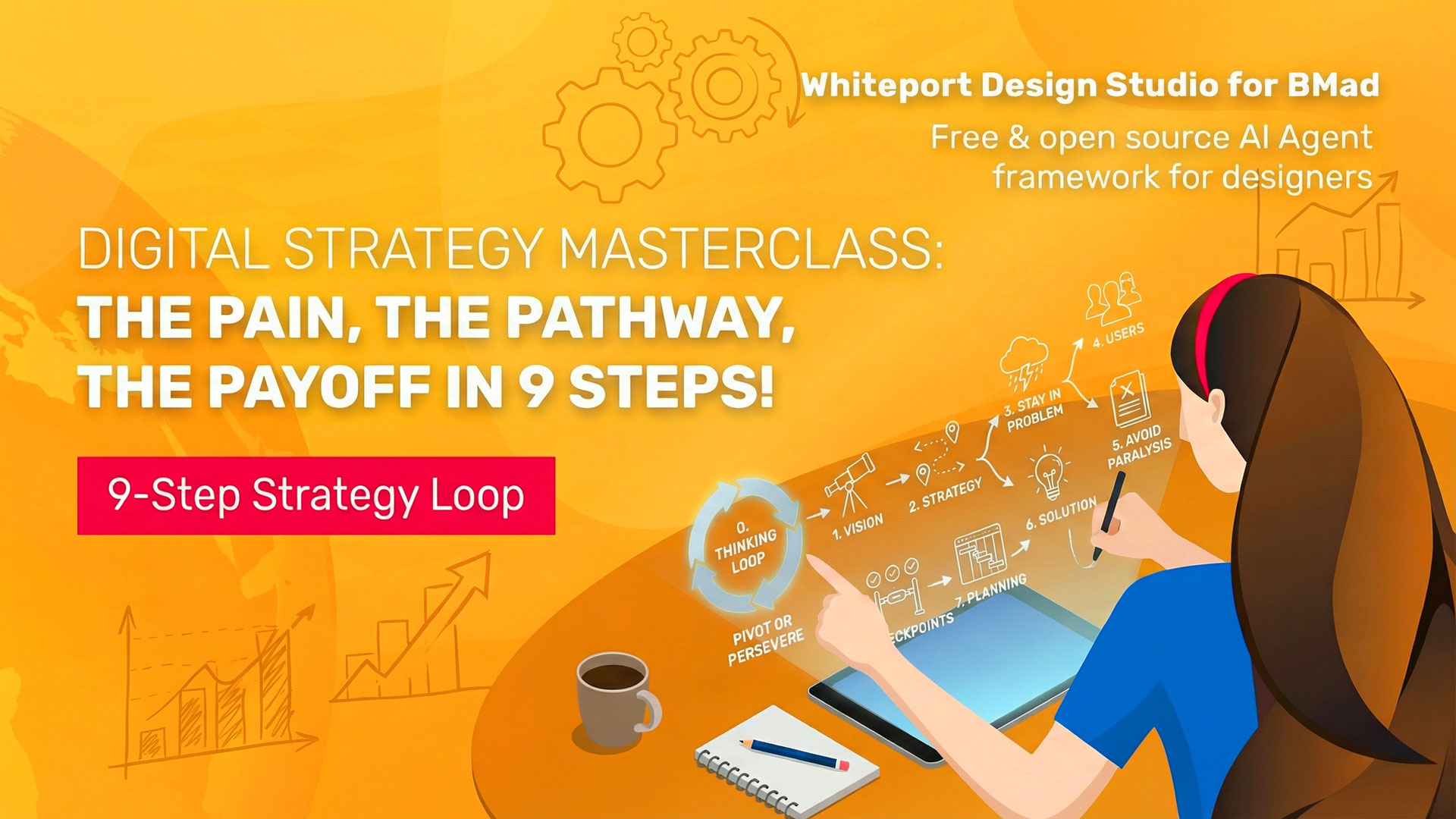
A 9-step masterclass in digital strategy: the pain, the pathway, the payoff!
 13 January 2026
 Marten Angner
Strategy is one of those words that gets tossed around like confetti, and then, with straight faces, expected to carry the weight of a company on its tiny paper shoulders. At Whiteport Design Studio, we treat strategy as a tool with a sharp edge: useful, deliberate, and not something you wave around like a buzzword bingo contest.
Working with digital strategy requires courage, because it asks you to stay in the problem while you explore the solution space with an open mind, methodically gathering signals and insights until you hit that breakthrough moment where everything clicks and the path forward suddenly becomes obvious. Not as the first idea you fall in love with in an instant, but as the outcome of feeding your brain enough relevant information and giving your team (and your AI assistants) the right constraints to work with.
Strategic thinking isn’t here to slow you down with stupid questions.
It’s here to focus your energy on what actually matters.
So get passionate about this part of project preparation like the whole project depends on it, because it does.
Because it does.
Overview: The Whiteport Strategy Thinking Loop
Here’s the map before the hike, the checklist before the chaos, the loop we return to whenever a team feels either stuck or suspiciously confident.
- Describe the desired state = vision. Make it concrete enough that people can disagree productively, because vague visions create polite meetings and sloppy decisions.
- Describe the current state = the challenge. What is true right now, what hurts, what is wasted, and what is being assumed without evidence.
- Who are we trying to create value for? Anchor your thinking with target group analysis, and define what your audience is actually trying to achieve.
- Stay in the problem on purpose. Sit with the tension long enough for understanding to form, because the first relief you feel is usually just the first shortcut.
- Interrogate the “why.” Use something like 5 Whys to dig past symptoms, so you don’t build an expensive band-aid and call it innovation.
- Generate options. Document the first idea, then force alternatives into existence, because comparison is how you earn certainty.
- Anchor to objectives. Rank the business goals and pressure-test each option against the top metric first, then the next, until the weak ideas politely fall apart.
- Plan in phases. Milestones, assumptions, risks, and checkpoints that reality can slap without destroying the whole project.
- Learn with real people. Build the smallest thing, show it to at least 5 users and 1 domain expert, then decide: pivot or persevere.
Then we loop.
And we get better.
1. Vision first, or you are just orbiting
A vision is a clear understanding of a desired state, expressed in a way that people can actually picture, argue with, and rally around, even when they’re tired, busy, or slightly allergic to change. It’s not a vague wish. Not a mood board. Not a slogan that looks great on a wall and means nothing in a meeting.
A strategy without a vision is going in circles.
You can move. You can be busy. You can even feel productive.
But you are still spinning.
So when you have your vision, it’s time to think about the journey to get there. This is where strategy stops being a buzzword and becomes a choice with consequences.
2. Strategy is the route from current to desired state
Strategy is the pathway we choose from the current state to the desired state, and the word choose matters because it implies trade-offs, constraints, and the uncomfortable truth that not everything can be priority number one.
A strategy includes which approaches we should use, which methods we’ll rely on, how we maximize our strengths, how we avoid pitfalls, and how we reduce resistance, both technical and human.
One common mistake is talking about strategy in plural.
Many people talk about all the strategies they have to reach an objective, when in practice you can only have one, because strategy is the coherent route you commit to, not a buffet you sample depending on mood.
The strategy can have several parts.
But it is always one.
And still, we’re not moving just yet.
At this point, we’re still at the start, staying with the challenge, and that can feel frustrating if you came into the room hoping for a shiny solution by lunch.
Good.
3. Staying in the problem: remember, pain is temporary, regret is forever
Almost every workshop method known to mankind embodies “staying in the problem,” because as you put effort into viewing, clarifying, and burning grey matter on the current challenge, your understanding deepens, your assumptions get exposed, and your team gradually stops talking past each other.
You are not wasting time here.
You are buying clarity.
And clarity is what makes execution fast later.
But here’s the problem.
Staying in the problem is painful.
As soon as you’re in the problem, you’re suffering, and it doesn’t matter whether the “problem” is a missed opportunity or an urgent issue, because your nervous system experiences both as tension, uncertainty, and the sense that something is not yet safe.
And while you’re in that state, your brain starts grasping for release.
Any release.
Which leads to the biggest pitfall in human thinking.
It turns out that very few people can operate effectively in low certainty. Experienced consultants get good at it through training.
You can too.
Falling in love with the first idea
Amateurs leave the problem at the first whim, and inexperienced thinkers run with whatever comes to mind, because an idea feels like oxygen when you’ve been underwater in uncertainty.
The danger is that the first idea is rarely the best idea.
It’s just the most emotionally relieving.
And emotions are talented liars when they’re trying to get you out of discomfort.
That’s why companies like Toyota are famous for forcing solutions through structured problem definition. The “5 Whys” practice, for example, isn’t about being slow or bureaucratic. It’s about documenting your thinking so you can prove you didn’t stop at the first convenient explanation, and it creates a cultural barrier against premature certainty.
Experienced consultants learn to be comfortable in the problem.
You should too.
But there’s also a trap on the other side of the same mountain.
4. Finding out “who wants what” in your project’s solution space
Knowing your customer is a fantastic way to create creative boundaries for your thinking, because clear people-thinking creates better product-thinking. When you define your target groups and get clear on what they actually want, you put everyone’s mind on high alert for good ideas, because you’ve turned guessing into observing.
We usually do this in two steps.
First, create your ICP (Ideal Customer Profile). Define the type of company, organization, or customer segment that gives you the best return on effort, and capture their pains and opportunities by speaking to what makes their world unique.
Second, identify the actual type of person you’re doing business with, because all business is done between people. Define a persona and clearly list what they want, what they fear, what they’re trying to achieve, and what they’re trying to avoid.
At Whiteport Design Studio, we use Trigger Mapping to identify both positive and negative driving forces:
- Positive: goals, wishes, dreams, ambitions
- Negative: fears, aversions, nightmares, and what they want to avoid
5. Analysis paralysis: when “why” becomes a hiding place
Staying in the “why” for too long is also a mistake, because analysis can become a socially acceptable way to avoid commitment, and commitment is where accountability begins.
Many lengthy reports have been written about issues without any solution being proposed, not because nobody had an idea, but because proposing a solution gets your name attached to it, and in low-trust environments people become reluctant to put their name on anything that might fail.
So the team keeps analyzing.
And analyzing.
And analyzing.
Toyota has a brutal antidote to this: A3 thinking (a one-page forced decision).
A business case is expressed on one A3 paper in landscape.
Left side: define the problem.
Right side: propose the solution.
You can’t hide behind page 48.
One page forces a decision.
6. Progress from strategy to solution focus!
When we have a clear understanding of the challenge, a defined vision, and a strategy, we start gathering clues for a solution, and those clues come from friction points in the current system, business objectives you can’t ignore, constraints you must respect, and patterns you notice when you stop trying to escape discomfort.
Sometimes you get the solution first, and strategic work is used to challenge that initial idea so you can keep what is strong and discard what is wishful thinking.
Other times you move methodically through the strategic steps until the pieces fall into place.
Either way, the process is the same.
Finding the right solution.
How to not marry your first idea
To avoid falling for the first idea that pops into your mind, force yourself to document it, generate alternatives, and compare options, even when it feels like overkill, because that friction is the price of not building the wrong thing with great confidence.
This is a skill.
And sometimes it requires balls of steel when the whole team is screaming to “just go with whatever is on the table,” because urgency can be real and still be misleading.
A good way to generate stronger alternatives is to list all the business objectives behind the solution, prioritize them, and ask what would happen if you were only allowed to deliver value to the most important metric.
That constraint reveals what is essential.
Everything else starts to wobble.
As you go down the list, you’ll often see that your darling idea isn’t the most practical, or that it only works if the world behaves nicely.
The world rarely behaves nicely.
The taboo question: should we live with the problem?
Another assumption is that the challenge is just one problem, or that it’s solvable with one solution, but reality tends to be messier than our PowerPoints.
What about the cost of the fix?
The disruption?
The maintenance?
The second-order effects that show up six months later when nobody remembers why you built the thing?
Are we really sure the juice is worth the squeeze?
Sometimes, by staying in the problem long enough, we realize that living with the issue might be less costly than trying to solve it.
That is not surrender.
That is strategy.
7. Planning: now we move, but the plan is not the point
Once we have a solution that aligns with vision and strategy, it’s time to plan, which means we take the roadmap implied by the strategy and break it into phases and milestones, so execution becomes a sequence of decisions rather than a foggy marathon.
Planning is where we translate intent into coordination, and it’s also where we surface risks early, because a plan is basically a list of assumptions wearing a suit.
The planning is the point.
The plan is nothing.
Napoleon Bonaparte is often credited with the idea that no plan survives contact with the enemy, and the reason is simple: reality gets a vote, and reality votes early and often.
So plans must be flexible.
One eye on the plan.
One eye on reality.
As we work, we gather evidence whether our plan is working or not, and evidence should be allowed to change our minds.
If we’re brave enough to look.
The first steps always feel like failure
In the beginning of a project it often feels like you’re getting nowhere, because most energy is spent setting everything up, everything looks like a mess, and everyone is running around like headless chickens with project boards and good intentions.
It’s easy to decide the solution was stupid, the market isn’t ready, or the idea is wrong.
And stop.
But you need to stick with the plan long enough to get factual data outside your emotional state.
Feelings are not reality.
The other mistake: pushing through obvious red flags
On the flip side, pushing through while evidence stacks up that the solution is failing is also a mistake.
Downplaying skepticism and dismissing different opinions is how you drive a project off a cliff with a confident smile.
Plenty of ventures have failed because consequences were ignored for too long, not because people were stupid, but because the social cost of saying “this isn’t working” felt higher than continuing.
So what’s the cure?
8. Checkpoints: talk to real people
We plan for checkpoints where we talk to real people, because feedback from reality is the only antidote to the fantasy that lives in our heads.
In software development, best practice is to make something simple, bring it to the target group, and learn.
The art isn’t just building the thing.
It’s asking the right questions without leading the witness.
A useful rule of thumb:
Show your thing to at least 5 users.
And 1 domain expert.
Then let the feedback actually sink in.
Lean Startup has a framework that captures this ritual beautifully. The point isn’t shipping for the sake of shipping. The point is validated learning.
The cycle looks like this:
- Define a minimum viable product (MVP)
- Produce it in the cheapest way possible
- Evaluate what we learned internally
- Show it to real people from the target group
- Evaluate the feedback and take notice
- Ask the big question: pivot or persevere
And there is our old friend again.
Discomfort.
Staying in the moment, letting everyone share their view, and asking for feedback is painful, because it feels like it takes too much time, it’s hard to find the right people, and we already suspect our solution is bad anyway, so why do we need other people to tell us?
The list of rationalizations to skip usability testing is endless.
But they all boil down to the same point.
Fear.
Fear of what people will say.
Fear of looking foolish.
Fear of having built a bad product.
When it comes to designing interactive products, “pain is temporary, regret is forever” actually has merit, because the pain of feedback happens now, while the regret of launching the wrong thing tends to arrive later.
Quietly.
With invoices.
AI is speeding up building, but keeping you ignorant
Here’s what worries me.
AI and “love-coding” tools have changed the texture of software development, and they can de-sensitize us to methodical thinking because they make it possible to produce something that looks finished before we’ve earned the right to believe we understand the problem.
Why plan when you can build the product in a couple of hours?
When thinking takes longer than building, why put two thoughts together when you could just ship and see what happens?
Because speed can be a trap.
When our thinking is clear, AI doesn’t have to make assumptions.
And when AI doesn’t have to guess, the team doesn’t have to clean up guesswork disguised as output.
We know what to build.
We become curious about the effect of our work.
And together, we build in accordance with a shared understanding of the world, which means less thrash, fewer debates about symptoms, and more energy spent on what actually matters.
And there is no better feeling.
How Whiteport can help
Whiteport is a digital agency based in Stockholm, Sweden. We help teams get clarity in their thinking, sharpen their solutions, and turn early ideas into design that can actually fly.
Need help with analysis, usability testing, digital strategy, social media, UX design, visual design, or production?
We’re here.
Whiteport Design Studio
Whiteport Design Studio is not a slide deck you admire and then ignore.
It’s a disciplined sequence that keeps teams honest while still moving forward:
Vision that people actually want.
One coherent strategy that chooses a route.
The courage to stay in the problem without falling in love too early.
The humility to test assumptions with real people.
Sketches elevated into interfaces, and interfaces turned into specifications your developers can actually use.
Plans that bend when reality speaks.
Evidence-driven decisions to pivot or persevere.
That is what strategy looks like when it is alive.
Not busy.
Alive.
///
Hi, I am Mårten, I am the founder of Whiteport, a Digital Agency from Stockholm. We make Apps, sites and E-commerse applications with the help of AI Agents! And we love it. Email me at marten@angner.se or find us on www.whiteport.com